

Start your Journey From Scratch!

Importance Of NCERT Notes in UPSC Preparation

NCERT (National Council of Educational Research and Training) notes are important for UPSC (Union Public Service Commission) preparation for several reasons:

1.Foundation Building: NCERT textbooks provide a solid foundation of fundamental concepts in various subjects such as history, geography, economics, political science, science, and mathematics. This foundation is crucial for understanding higher-level topics covered in UPSC exams.

2.Clarity and Conciseness: NCERT notes are known for their clarity and concise explanations. They present complex topics in a simplified manner, making it easier for aspirants to grasp difficult concepts.

3.Aligned with UPSC Syllabus: The UPSC syllabus often overlaps with topics covered in NCERT textbooks, especially for subjects like history, geography, polity, and economics. Studying NCERT notes ensures that aspirants cover the essential topics required for the exam.

4.Language and Writing Style: UPSC exams demand clear and effective communication skills. By reading and summarizing NCERT notes, aspirants can improve their writing style, vocabulary, and articulation of ideas, which are essential for answering UPSC exam questions.

5.Illustrative Examples: NCERT textbooks include numerous examples and illustrations to explain concepts. These examples not only aid in understanding the subject matter but also provide valuable insights that can be used in answers during the UPSC exam.

6.Historical Context: NCERT notes offer valuable insights into historical events, their context, and their impact on society and governance. Understanding historical context is crucial for answering questions related to current affairs and policy issues in the UPSC exam.

Overall, NCERT notes serve as a comprehensive resource for building a strong foundation of knowledge and skills required for success in the UPSC exam.

NCERT Books for UPSC Preparation

UPSC Preparation Books from NCERT History Books:

  • History: NCERT Class VI - Our Past

  • History: NCERT Class VII - Our Past - I

  • History: NCERT Class VIII - Our Past II and III

  • History: NCERT Class IX - India and the Contemporary World - I

  • History: NCERT Class IX - India and the Contemporary World - II

  • History: NCERT Class X - Themes In World History

  • History: NCERT Class XII - Themes In Indian History - I

  • History: NCERT Class XII - Themes in Indian History - II

  • History: NCERT Class XII - Themes In Indian History - III

  • NCERT Books about Indian Society for UPSC exam:

  • Indian Society: NCERT Class VI - Social Science: Social & Political Life I

  • Indian Society: NCERT Class VII - Social Science: Social & Political Life II

  • Indian Society: NCERT Class VIII - Social Science: Social & Political Life III

  • Indian Society: NCERT Class XI - Sociology: Understanding Society

  • Indian Society: NCERT Class XII - Indian Society

  • Indian Society: NCERT Class XII - Social Change and Development in India

  • IAS aspirants can also refer the class 12 book for Sociology.

  • NCERT Indian Art and Culture books for UPSC:

  • Art & Culture: NCERT Class XI - An Introduction to Indian Art

  • Art & Culture: NCERT Class XI - Living Craft Traditions of India (Chapters 9 & 10)

  • UPSC Preparation Books from NCERT Geography Books for IAS:

  • Geography: NCERT Class VI - The Earth Our Habitat

  • Geography: NCERT Class VII - Our Environment

  • Geography: NCERT Class VIII - Resource and Development

  • Geography: NCERT Class IX - Contemporary India - I

  • Geography: NCERT Class X - Contemporary India - II

  • Geography: NCERT Class XI - Fundamentals of Physical Geography

  • Geography: NCERT Class XI - India - Physical Environment

  • Geography: NCERT Class XII – Fundamentals of Human Geography

  • Geography: NCERT Class XII – India – People and Economy

  • Additional IAS preparation books for reference: Old NCERT books for History (Pre 2000s):

  • Ancient India (class XI) by RS Sharma: This covers the ancient Indian history syllabus completely

  • Alternative Published version: India’s Ancient Past – RS Sharma: Covers all of the NCERT syllabi for IAS and is more detailed in all aspects. Should be a good substitute

  • Medieval India (class IX) by Satish Chandra

  • Alternative Published version: History of Medieval India – Satish Chandra: More detailed than the NCERT but less easy to read. NCERT would be better

  • Modern India (class X) by Bipin Chandra: Best book for UPSC Medieval History

  • Alternative Published version: India Before Independence: Bipan Chandra’s published book is readily available and is more comprehensive, but the NCERT is more objective and more comfortable to read

  • World History (Class X): Should be enough for an intro to world history

  • Continue reading below to know which NCERT books to study for IAS for General Studies Paper-II.

    NCERT UPSC Preparation Books for General Studies Paper-II:

  • Polity NCERT Books for UPSC

  • Polity: NCERT Class IX - Political Science: Democratic Politics Part – I

  • Polity: NCERT Class X – Political Science: Democratic Politics Part – II

  • Polity: NCERT Class XI – Political Science: Indian Constitution at Work

  • Polity: NCERT Class XII – Political Science I: Contemporary World Politics

  • Polity: NCERT Class XII – Political Science II: Politics in India since Independence

  • For Polity: Class 9 to 12 NCERT books should be read in detail, with a focus on 11th and 12th (of which World Politics, only if time permits).

  • Read on for information on which books to read for UPSC GS Paper III.

    UPSC Books from NCERT for General Studies Paper III:

    NCERT Books on Economy for UPSC

  • Economy: NCERT Class IX – Economics

  • Economy: NCERT Class X – Understanding Economic Development

  • Economy: NCERT Class XI – Indian Economic Development

  • Economy: NCERT Class XII – Introductory Microeconomics
  • Economy: NCERT Class XII – Introductory Macroeconomics

  • Science & Technology IAS Preparation Books from NCERT

  • Science: NCERT Class VI

  • Science: NCERT Class VII

  • Science: NCERT Class VIII

  • Science: NCERT Class IX

  • Science: NCERT Class X

  • Science: NCERT Class XI – Chemistry: Unit 14 & Biology: Units 4 & 5

  • Science: NCERT Class XII – Chemistry: Unit 16 & Biology: Units 8, 9 & 10

  • UPSC Books from NCERT on Environment & Ecology

  • Science: Class XII – Biology: last four Chapters (13 to 16)

  • For Economics: Reference of class 9 to 12 NCERT books for IAS should be ideal, but if you are familiar with the subject, class 11 and some chapters in class 11 and class 12 (micro + macro) would be sufficient. So, read selectively!

  • For Science: Refer textbooks of class IX and X that would be good enough for your IAS exam preparation.

  • The next list covers IAS Books from NCERT for Civil Services GS IV.

  • NCERT IAS Books for General Studies Paper IV:

  • Ethics: NCERT Class XII – Psychology: Not too significant from the exam perspective, however good for some basics. Read selectively.


  • Importance of Good IAS Books

  • UPSC Prelims 2024 was held on 28th May, 2023.

  • UPSC Prelims 2024 is scheduled for 26th May 2024.

  • To follow up on the upcoming civil services examination, aspirants may check UPSC Calendar in the linked article.

  • Out of a plethora of study material available both online and offline, it is crucial that the candidates select the best books for UPSC IAS preparation.

  • IAS toppers recommend that aspirants start their UPSC preparation with NCERT books and then move on to the standard reference books.

  • The best IAS books can vary from candidate to candidate depending on their previous expertise and knowledge of the subject matter. However, the UPSC booklist recommended by experts are listed in this article subject-wise.

  • Choosing the right IAS exam books online for different stages of the UPSC exam is quite important. The UPSC Prelims comprises only objective type questions while the IAS Mains contains descriptive essay type question papers.

  • Not only should the candidates be selective about the UPSC preparation books but also divide the reading list into Prelims and Mains preparation.

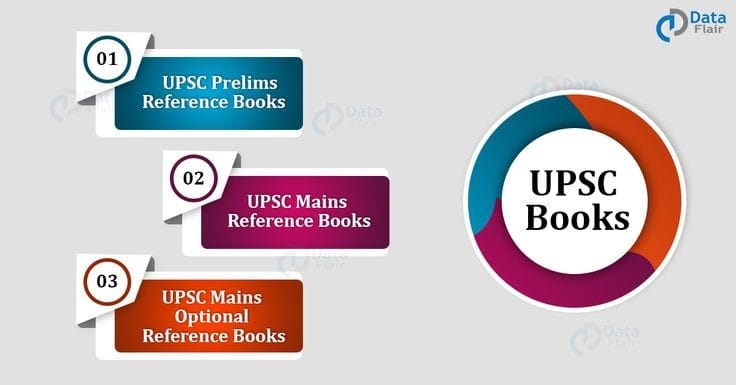
  • UPSC BOOKS - Best Books For UPSC Prelims

    There are 2 papers in the Prelims for General Studies Paper – I and CSAT & both are of objective type with negative marking. Here are the best IAS Prelims Best Books given below -

    Subject UPSC Book list
    History
    • NCERT 11th Ancient and Medieval
    • NCERT 12th Modern Indian History
    • Indian Art & Cukture by Nitin Singhania
    • India's Struggle for Independence -
           Bipin Chandra
    Geography
    • NCERT VI-X Old Syllabus
    • NCERT XI,XII New Syllabus
    • World Atlas (Orient Black Swan)
    • Certificate Physical Geography - G C
            leong
    Indian Polity
    • NCERT IX-XII
    • Indian Polity - M Laxmikanth
    • NCERT XI
    • Economic Development & Policies in India - Jain & Ohri
    Economics
    • Indian Economy by Nitin Singhania
    International Relations
    • Current Affairs
    • NCERT XII (Contemporary World Politics)
    CSAT
    • Tata McGraw Hill CSAT Manual
    • Verbal & Non-Verbal Reasoning by R S Aggarwal
    Solved Papers
    • IAS General Studies Prelim Solved Papers by Vishal Publications

    UPSC PreparationBook List - Best For IAS Mains

    The candidates who qualify for the UPSC prelims examination will be eligible for the IAS Mains examination. There are 9 theory papers out of which 2 papers are optional. The candidates can follow the given book details for the preparation of the UPSC Preparation 2023 – Here, we have mentioned the best general studies books for the UPSC Mains 2023 –

    Subject UPSC Books
    History,Indian Heritage & Culture [GS Paper 1]
    • Ancient India by RS Sharma
    • India after Independence by Bipan Chandra
    • History of Medieval India by Satish Chandra
    • Indian Art and Culture by Nitin Singhania
    • India’s Struggle for Independence by Bipan Chandra
    Geography [GS Paper 1]
    • Ancient India by RS Sharma
    • India after Independence by Bipan Chandra
    • History of Medieval India by Satish Chandra
    • Indian Art and Culture by Nitin Singhania
    • India’s Struggle for Independence by Bipan Chandra
    Polity & International Relations [GS Paper 2]
    • Introduction to the Constitution of India by DD Basu
    • Indian Polity by M. Laxmikanth
    • International Relations: Pushpesh Pant
    Economy [GS Paper 3]
    • Environment and Disaster Management by Tata McGraw Hill
    • Indian Economy – Nitin Singhania
    • Challenges to Internal Security of India by Ashok Kumar
    Ethics [GS Paper 4]
    • Ethics, Integrity and Aptitude for Civil Services Main Examination by Subba Rao and P.N. Roy Chaudary
    Solved Papers
    • IAS General Studies Prelims Solved Papers – Vishal Publications

    UPSC Book List For Optional Subjects

    Subjects UPSC Books
    Agriculture
    • Agronomy By Yellamananda Reddy
    • Soil Science – D.K Das Or Brady
    • Genetics By B.D.Singh
    • Entomology – Vasantha Raj & David
    • Special Issue of Agriculture by The Hindu
    Anthropology
    • N. Hasnain: Tribal India
    • Herskovits: Cultural Anthropology
    • Surender Nath: Forensic Anthropology
    • Herskovits: Cultural Anthropology
    • Stein & Rowe: An Introduction to Physical Anthropology
    Botany
    • Taxonomy: Nair along with Datta
    • Embryology: Bhojwani and Bhatnagar
    • Physiology and Biochemistry: Salisbury and Ross or Fritz and Noggle
    • Economic Botany: Kochar or Verma
    Chemistry
    • Theoretical principles of inorganic chemistry – G.S. Manku,
    • Extradiction of metals, Principle of inorganic chemistry – Puri, Sharma, Jauhar.
    • Advance physical chemistry – Gurdeep Raj
    • A guide to mechanism in organic chemistry – Peter Sykes
    Economic
    • International Economics – Bo Soderston
    • National Income Accounting – Bakerman
    • Banking – S.B. Gupta
    • International Trade – Bo Soderston
    History
    • History of Modern India – Shekhar Bandopadhyaya/Bipan Chandra
    • India’s Ancient Past – R.S. Sharma
    • The Wonder That Was India – A.L. Basham
    • Ashoka and the Decline of the Mauryas – Romila Thapar
    • India’s Struggle For Independence – Bipan Chandra and Others
    Management
    • Financial: Pandey/Chandra/Khan & Jain/Bearley
    • Economics: Any good economics book
    • Operations: Adams/Taha
    • Organisational Design: Khandwala; Madhukar Shukla
    Mathematic
    • Ordinary Differential EQs:- MD Raising Lumina, Golden series-NP Bali
    • Real Analysis – Shantinarayan, Royden
    • Linear Programming – SD Sharma
    • Solid Mechanism – Kazmioo
    Electrical Engineering
    • Modern Central Engineering – Ogata
    • Electromagnetic Waives and Field – R.N. Singh
    • Surveying and Levelling – T P Kanetakar
    • Heat Conversion – Arora & Kundwar
    Urdu
    • Urdu Shairi ka Tauqidi Mutala – Suenbul Nigar
    • Urdu Nasr ka Tauqidi Mutala – Suenbul Nigar
    • Urdu Adab Ki Tarikh – Noorul Hasan Naqvi
    Psycology
    • Psychology Robert A Baron
    • Social Psychology Baron & Byrne
    • The Psychology of Small Groups Shaw

    How to prepare For a UPSC Interview?

    UPSC Interview

    The UPSC interview, also known as the Personality Test, is the final stage of the Civil Services Examination. It aims to assess the candidate’s suitability for administrative roles. The interview panel evaluates the candidate’s communication skills, depth of knowledge, analytical ability, and overall personality. It is important to be well-prepared, confident, and articulate while answering questions to leave a positive impression. The personality test assesses your intrinsic personality rather than your knowledge (which was previously examined in the mains and preliminary exams). In addition to the total 2025 marks, the UPSC Interview procedure lasts roughly 30 minutes and is worth 275 points. This 30-minute procedure can transform your life and make your ambition of working for the government a reality. Based on the results of the Personality Test and the main examination, the final merit list is created. For applicants, a good interview score may significantly improve their rank & chances of receiving better treatment.

    Importance of DAF (Detailed Application Form) for UPSC Interview

    To successfully answer the questions asked during the UPSC interview, it is crucial to understand every single component of your detailed application form carefully. The panel’s information on you drives all of the fundamental inquiries addressed in the UPSC interview. Therefore, it is crucial to carefully fill out the entire application form and properly prepare it.

    Watch Mock Interview by Air 1 Aditya Srivastava (Rank 1 CSE 2023)

    Watch Mock Interview by Air 1 Ishita Kishore (Rank 1 CSE 2022)

    Watch Mock Interview by Air 3 Gamini Singla (Rank 3 CSE 2021)

    Tips to prepare for a UPSC Interview

  • Get The Components of your DAF
  • Everything you listed on the DAF, including the significance of
    your name and the prominent features of your area, may be
    discussed during the interview. Therefore, read the form many times,
    list all possible questions, and prepare succinct responses.

  • Opinions On Current Events
  • Prepare your three-month supply of current events so that you can
    respond to queries about them succinctly and briefly. As yourespond
    to such inquiries, be sure to be upbeat.



  • Responding to Hypothetical Inquiries
  • You should know an IAS/IPS/IFS officer’s legal rights and obligations.
    You must respond to the inquiries in a manner that avoids
    going above and beyond to address the issue. Your responses must fall within
    the purview of the legal authority granted to you by your profile.

  • Responding to Behavioural Inquiries
  • When responding to the questions, be composed and calm,
    project confidence, and be direct if you are unsure of the answers.
    You may skip the question and respond,“I’ll have to take it for
    now; I’ll have to read more about it.”


  • Don't Be Overconfident
  • Knowledge is undermined, and arrogance results from
    overconfidence. Never overestimate your chances of luck
    sticking with you since you never know when it could.
    Although the UPSC interview is challenging, you may succeed
    with confidence and a good outlook. Pay careful attention to
    the questions being asked by the interview panel.

  • Be Cautious While Selecting Your Words
  • Try to be eloquent while responding to the questions, as the
    interview panel is more concerned with how you talk and the
    words you choose to convey your ideas


  • Do Not Lie
  • One of the most important interview tips is this!
    Please don’t make up your replies with phoney facts;
    they’ll probably figures it out immediately and catch you

  • Mock Interview
  • You may prevent blunders by practising the mock
    interview before the actual interview. Your friends and
    knowledgeable mentors may aid you in that.


  • Wear Clean and Comfy clothes
  • Dress formally for the day of the interview since you should
    seem professional. Dark pants and a light-coloured shirt are
    appropriate for males to seem professional. For female
    candidates, a plain saree or churidar is advised.

  • Document - Check
  • Doing a document check in advance is crucial to preventing
    the last-minute rush. Make sure you have all the
    paperwork organised and available in one file.



  • Get Enough Rest
  • Don’t sleep all day. If you worry a lot about the interview,
    it can affect your effectiveness. Get a good night’s
    sleep the night before & try not to worry too much!

  • Understanding the Interview's True Objective
  • The main goal of the interview is to evaluate the candidate’s
    potential for having good administrative abilities. The panellists’
    purpose is to evaluate a candidate’s personality for civil service,
    not to test their knowledge.

    Questions, rebuttals, hypothetical case studies, etc., elicit your
    personality qualities and evaluate you based on your responses,
    mental clarity, body language, etc. Never assume that the board
    members are out to get you or to make you seem bad.
    You ought to think positively.

    Watch Srushti Deshmukh MOCK Interview (Rank 5,CSE 2018)

    Watch Apala Mishra MOCK Interview (Rank 9,CSE 2020)

    Watch Akshat Jain MOCK Interview (Rank 2,CSE 2018)

    Conclusion

    The UPSC interview is a personality exam. So, try to be sincere
    and convey your thoughts. Please put on a business dress to
    make yourself seem professional. Make sure you have all the
    necessary papers with you. Aspirants should form a small group
    to debate ideas and attempt to attend as many interview
    sessions as possible to determine their strengths and limitations.
    Utilise constructive criticism in the mock interviews and work to
    enhance those areas. Finally, approach the interview with
    complete confidence and avoid putting too much pressure on yourself.

    ONLINE PAID COURSES!!


    ONLINE FREE COURSES!!

    Dr. Tanu Jain - (Tathastu-ICS)